What Is Divorce Mediation? A Guide To A New Beginning 2026
 Jonathan Wong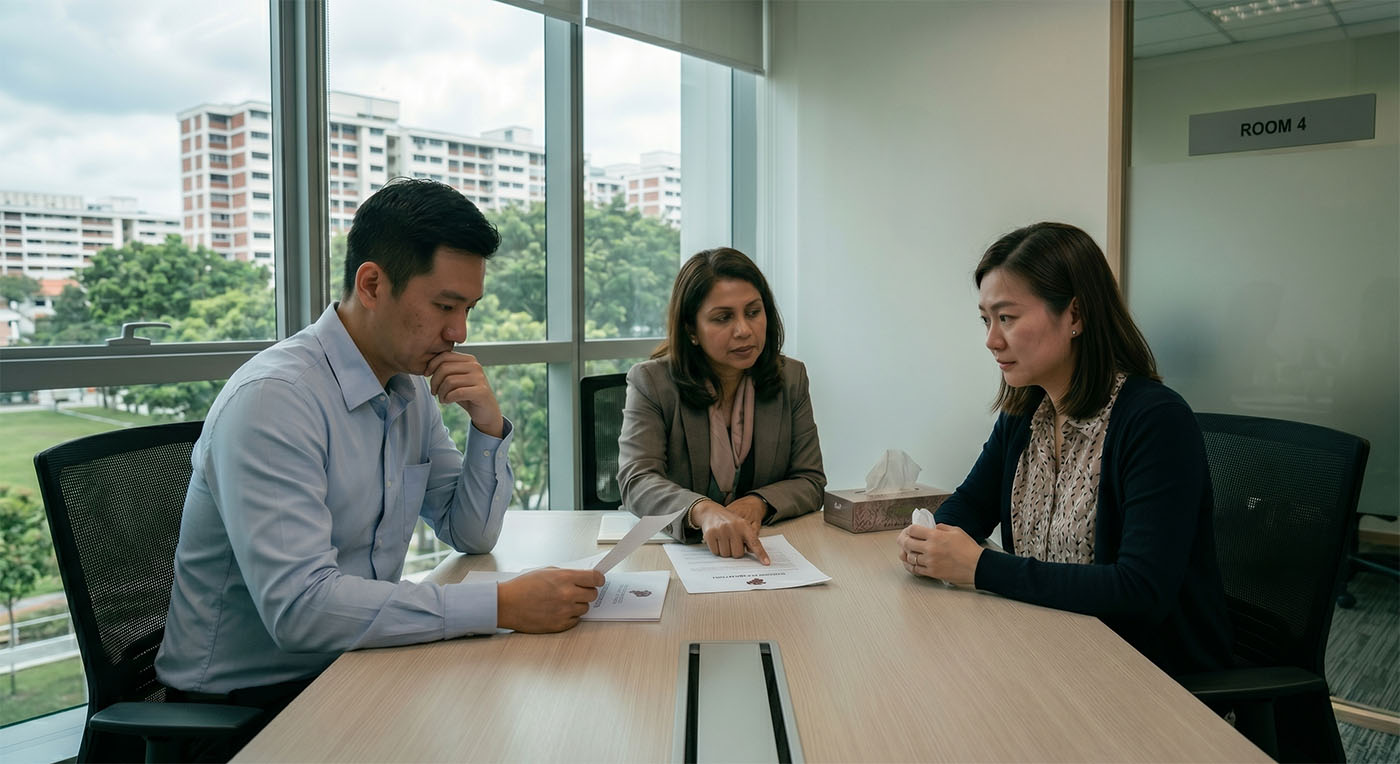
A quick summary of what you'll learn from this article
Divorce Mediation in One Sentence
Mediation is a confidential, facilitated conversation between two parties in dispute, guided by a neutral third party (the mediator), with…
The Three Compulsory Processes You Need to Understand
This is the most important distinction in Singapore Divorce mediation, and the one that confuses most people.
How Does Divorce Mediation Work?
The process of mediation for Divorce typically follows a clear trajectory, whether it is conducted at the Family Justice Courts (FJC).
Divorce mediation sits between private negotiation and full litigation: more structured than a conversation between lawyers, less adversarial and expensive than a contested hearing before a judge. For most couples, it is the mechanism through which a Divorce that started as contested ends up settled.
Understanding what mediation is, which processes are compulsory, who the mediator is, what you need to prepare, and what happens if it fails is essential knowledge for anyone going through a Divorce in Singapore with unresolved matters.
Divorce Mediation in One Sentence
Mediation is a confidential, facilitated conversation between two parties in dispute, guided by a neutral third party (the mediator), with the goal of reaching a binding agreement without a contested Court hearing.
The mediator does not make decisions for you. They are not a judge. Their role is to help both parties communicate clearly, identify their underlying interests, understand their realistic options, and move toward workable compromises. Any agreement reached in mediation becomes binding only when it is recorded in writing, signed by both parties, and endorsed as a consent order by the Court.
The Three Compulsory Processes You Need to Understand
This is the most important distinction in Singapore Divorce mediation, and the one that confuses most people. There are three separate compulsory processes for divorcing parents. They are not interchangeable, they do not replace each other, and they happen at different points in the process.
1. The Co-parenting Programme (CPP): Before You File
Since 1 July 2024, under Section 94A of the Women’s Charter, all parents with children under 21 must complete the Co-parenting Programme before they can file for Divorce under any track, contested or uncontested. This requirement is absolute and applies even where both parents agree on all matters.
The CPP equips parents with skills and strategies to support their children’s well-being during and after the Divorce. Both parents attend. On completion, you receive a Certificate of Completion, which must be filed with your Divorce application.
The CPP is not mediation. It is a parenting skills programme. But it is the compulsory first step in the process for parents with children, and your Divorce application cannot be filed without it.
2. The Child Focused Resolution Centre (CFRC): For Families with Children Under 14
If you are divorcing with at least one child under 14, and your Divorce is contested, you will be directed to the Child Focused Resolution Centre. Attendance is mandatory.
The CFRC process involves:
– An intake assessment by a Court family counsellor.
– Counselling sessions focused on the co-parenting relationship and the children’s needs.
– A mediation session conducted by a Judge-Mediator and family counsellors.
Both parties’ lawyers (if engaged) attend the first session. The process is conducted in strict confidence. Nothing disclosed at CFRC can be used as evidence in Court if mediation fails.
If agreement is reached, it is recorded as a consent order by the Judge-Mediator at the point when the Interim Judgment is granted. The process is free of charge.
3. The Family Dispute Resolution (FDR) Division: For All Contested Ancillary Matters
The FDR Division is the Family Justice Courts’ dedicated mediation and dispute resolution service for contested Divorce proceedings involving children under 21. Referral is compulsory in these cases.
The FDR process covers all ancillary matters: division of matrimonial assets, the matrimonial home, CPF, child custody and access, child maintenance, and spousal maintenance. Both parties’ lawyers attend. The mediator is typically a Judge-Mediator or a trained staff mediator from the Court.
FDR mediation is free. It is designed to resolve matters efficiently and confidentially before they consume the time and cost of a fully contested hearing.
How Does Divorce Mediation Work?
The process of mediation for Divorce typically follows a clear trajectory, whether it is conducted at the Family Justice Courts (FJC).
1. The Opening Statement and Ground Rules
The session begins with the mediator setting the stage. They will explain their neutral role and the confidential nature of the proceedings.
This confidentiality is a cornerstone of Singapore’s Divorce laws; anything said during mediation generally cannot be used as evidence in court later if the mediation fails. This allows both parties to speak freely without fear of legal repercussions.
2. Identifying the Issues
Once the ground rules are established, each party can share its perspective. The mediator helps to identify the specific areas of disagreement. In a Divorce context, these usually fall into two categories:
- Ancillary Matters: This includes the division of matrimonial assets, spousal maintenance, and the split of the family home.
- Children’s Issues: This covers custody, care and control, and access arrangements.
3. The Joint Session and Private Caucuses
The mediator facilitates a joint discussion to find common ground. However, if tensions run high, the mediator may use “caucusing.” This is where the mediator speaks privately with each party in separate rooms.
During these private sessions, the mediator can explore “hair-on-fire” concerns, such as immediate financial stability or child-related anxieties, that a party might be hesitant to voice to their spouse. This helps the mediator understand the underlying interests behind the legal demands.

4. Negotiation and Option Generation
With the issues identified, the focus shifts to brainstorming solutions. Unlike a Court judgement, which is often binary (one person wins, one loses), mediation allows for creative problem-solving. For example, instead of a standard alternate-weekend access schedule, parents might agree on a flexible arrangement that accounts for their specific work shifts or the child’s school activities.
5. Reaching an Agreement (The Consent Order)
If a compromise is reached, the mediator helps the parties draft a Draft Consent Order. In Singapore, this document is then sent to the Court to be recorded as a Consent Order. Once the Court seals this order, it carries the same legal weight as a judgment delivered by a judge after a trial.
6. When No Agreement is Reached
If parties remain at an impasse, the mediation is deemed “unsuccessful.” The case will then proceed to the next stage of the litigation process, which may involve further Court mentions or a full Ancillary Matters hearing. Even in these cases, mediation is often considered beneficial, as it clarifies the points of contention and potentially shortens the eventual Court battle.
What Happens in the Mediation Session
FDR mediation sessions are typically two to three hours each. Both parties attend, usually with their lawyers. The mediator opens by explaining the process, confirming confidentiality, and identifying the key issues to be addressed.
The mediator may speak to both parties together, or may hold separate private sessions (called “caucuses”) with each party and their lawyer. In private caucuses, the mediator can explore each party’s real underlying concerns, reality-test their positions, and help them consider the other side’s perspective without the defensiveness that often accompanies joint sessions.
What Is Mediation in Divorce Compared to Litigation?
To truly understand what mediation in Divorce is, one must compare it to litigation. While both aim to resolve the end of a marriage, they operate on entirely different philosophies.
| Factor | Mediation (FDR) | Full Contested Trial |
|---|---|---|
| Cost | Legal fees only (mediation is generally free in FJC). | Legal fees plus trial preparation, expert witnesses, and a longer timeline. |
| Timeline | Typically resolved within the standard timeline (6-12 months). | 12 to 24+ months from the initial filing. |
| Control over outcome | Both parties negotiate and agree to the terms. | A Judge makes the final, binding decision. |
| Confidentiality | Absolute: nothing disclosed in FDR may be used in Court. | Court hearings are generally accessible to the public. |
| Certainty | The outcome is known once the agreement is signed. | Outcome remains uncertain until the final judgment is delivered. |
| Effect on children | Less adversarial, resulting in lower emotional impact. | Prolonged conflict increases children’s stress. |
| Settlement rate | Approx. 70% full settlement, 85% partial at FDR. | By definition, 0% settlement (cases that reach trial were not settled). |
What Issues Can Be Resolved Through Mediation?
Mediation in Singapore Divorce proceedings can address all ancillary matters, including:
- Division of matrimonial assets: the family home, CPF savings, bank accounts, investments, business interests, vehicles, and personal property.
- The HDB flat: whether to sell, retain, or transfer, and under what CPF and HDB conditions.
- Child custody and care arrangements: custody type, which parent the child lives with, school, healthcare decisions, and religious upbringing.
- Access schedules: weekday access, weekend access, school holiday division, and special occasions.
- Proposed Parenting Plan terms: the detailed document required for all cases with children under the Family Justice Rules 2024 rules.
- Child maintenance: amounts, duration, payment method, and adjustment mechanisms.
- Spousal maintenance: whether any is payable, amount, duration, and conditions.
- Joint debts: how shared liabilities are apportioned.
What Is Family Mediation for Parents?
Family mediation provides a safe space to discuss sensitive topics like:
- Custody, Care, and Control: Deciding who the child lives with and who makes the major decisions regarding their education, religion, and healthcare.
- Access Arrangements: Crafting a schedule for the parent who does not live with the child. Mediation allows for a more nuanced approach than a Court order, such as detailing pick-up points, public holiday rotations, and even video call schedules.
- Co-parenting Communication: The mediator helps parents establish ground rules for how they will communicate moving forward, reducing the likelihood of future friction.

The Benefits of a Collaborative Approach
Choosing a collaborative approach like mediation offers benefits that extend far beyond the legal conclusion of a Divorce.
- Preservation of Relationships: For parents, your relationship does not end; it changes. Mediation fosters the communication skills needed to co-parent effectively for years to come.
- Higher Compliance: People are much more likely to follow a Court order that they helped create. Because the terms are reached by mutual agreement, there is usually a higher rate of voluntary compliance compared to a Judge’s order.
- Emotional Closure: The Court process is clinical. Mediation allows for a level of dialogue that can provide emotional closure, helping both parties transition into their new lives with less bitterness.
- Flexibility: Whether it is how to handle the family pet or how to split air miles, mediation can address smaller, personal details that a Court might consider too minor to address.
Can You Be Forced Into an Agreement During the Mediation Process?
A common concern for many is the fear of being pressured into signing a settlement they do not agree with. In the Singapore legal system, the answer is a clear no. Mediation is a voluntary and consensual process. Unlike a hearing where a Judge issues a mandate, mediation relies entirely on the willingness of both parties to find a middle ground.
Even when the Court orders parties to attend mediation, which is often the case for parents with children under 21, the obligation is only to attend and participate in good faith. There is no legal requirement to reach a settlement.
If you feel that the proposed terms are unfair or do not protect your future interests, you have the absolute right to decline the agreement. In such instances, the matter will simply proceed to be heard by a Judge in a Divorce hearing. The power remains with you to decide what is acceptable for your life.
What Is the Role of the Mediator in a Divorce Mediation?
The mediator serves as a neutral facilitator rather than a legal advisor or a Judge. Their primary objective is to manage communication between you and your spouse to determine whether a resolution is possible.
In Singapore, mediators are highly trained professionals who remain impartial throughout the Divorce proceedings. Their role includes:
- Facilitating Dialogue: They ensure that both parties have an equal opportunity to speak and be heard, preventing the conversation from becoming one-sided or overly aggressive.
- Reframing Issues: Mediators help translate emotional grievances into practical problems that can be solved. For instance, they might help shift a conflict about the family home into a discussion about financial security and housing needs.
- Reality Testing: The mediator may gently challenge the expectations of both parties. They might ask questions to help you consider how a certain proposal would work in real life, such as the logistics of a specific access schedule for your children.
- Maintaining Confidentiality: They ensure that the entire session remains private. This is a protected space where you can explore options without those discussions being used against you later in Court.
Types of Mediation Available in Singapore
Facilitative Mediation
The standard form of mediation is described above. The mediator facilitates communication and helps parties find their own resolution. The mediator does not evaluate the merits of either party’s position or advise on likely Court outcomes.
Evaluative Mediation
In evaluative mediation, the mediator (typically a senior lawyer or judge) gives a non-binding opinion on the likely outcome if the matter went to trial. This is used when parties are at an impasse and need an authoritative reality check before committing to further litigation.
Evaluative mediation is particularly useful where one party has significantly unrealistic expectations about what a trial would deliver. Hearing an experienced evaluator say “on these facts, the likely range of outcomes at trial is X to Y” can move stuck negotiations more effectively than facilitative discussion alone.
Court-Based Mediation vs Private Mediation
Court-based mediation (FDR and CFRC) is compulsory, free, and conducted by Court-appointed mediators. It is available to all couples with children going through contested Divorce proceedings.
Private mediation is voluntary, fee-based, and can happen before or during formal Divorce proceedings. The significant advantage of private mediation before filing is that if you resolve all matters in advance, your case qualifies for the simplified (uncontested) track, avoiding FDR entirely and substantially reducing time and cost.
From our practice — Jonathan Wong
“We acted for a woman in her late thirties who had been referred to the Divorce Support Specialist Agency before her case was filed in the Family Justice Courts. She refused mediation outright because she believed it was a process designed to pressure her into accepting less than she deserved. Her husband had wronged her, and she wanted a judge to say so publicly.
Eighteen months of contested proceedings later, she had spent considerably more than she recovered and the process had left both children badly affected. The financial settlement reached through litigation was not materially better than what the mediator had proposed in the first session. The lesson is one I share with every client at the outset: mediation is not about who is right. It is about what you can live with when it is over.”
Conclusion About Divorce Mediation In Singapore
Going through a contested Divorce and not sure what to expect at mediation?
How you prepare for mediation matters as much as what happens in the hearing room. Understanding the options available to you, such as mediation, can provide a clearer and more peaceful path forward.
At Tembusu Law, our team includes experienced Criminal lawyers and Divorce lawyers in Singapore who are dedicated to helping you find the most constructive way through your legal challenges.
Frequently Asked Questions About Divorce Mediation In Singapore
What Does Mediation Mean When Going Through A Divorce?
In a Singapore Divorce, mediation is a confidential process in which a neutral third party helps you and your spouse reach a mutual agreement outside the courtroom. It serves as a constructive alternative to a trial, allowing both parties to resolve disputes over assets and children through dialogue rather than litigation.
What Are The 5 Steps Of Mediation?
The process generally involves an opening statement, a joint discussion to identify issues, private caucuses with the mediator, a negotiation phase to find solutions, and the final drafting of a settlement agreement. These stages ensure that both parties have a safe and structured environment to explore potential compromises.
What Are The 4 Types Of Mediation?
The four primary styles used in various legal contexts are facilitative, evaluative, transformative, and the hybrid med-arb model. In Singapore, family matters, facilitative mediation is most common as it focuses on helping parents communicate and reach their own voluntary decisions.
What Should You Not Say During Mediation?
You should avoid using blaming language, making rigid ultimatums, or engaging in personal attacks that can derail the negotiation. Focusing on the past rather than future solutions often increases tension and makes it harder to reach a settlement that the Court will approve.
Is Mediation Only For Couples Who Get Along?
Not at all, as mediation is specifically designed to help high-conflict couples reach a resolution through structured communication. The mediator can use separate rooms to ensure both parties feel safe while working toward a legally binding agreement for their Divorce.
How Do I Prepare For A Mediation Session?
You should prepare by gathering all relevant financial documents and by thinking clearly about your children’s daily needs and future welfare. It is also wise to seek legal advice from Tembusu Law to understand your legal standing before the session begins.
Can We Mediate Even After Starting A Court Case?
Yes, the Singapore Court encourages settlement at any point, and you can pause active litigation to attempt mediation even if you have already filed your papers. This can lead to a faster resolution and significantly reduce the overall emotional and financial cost of your Divorce.
About the Author
No obligation. Strictly confidential.